
Calling Community Pilots: 14 New Open Science Lessons for Library Carpentry
The Lessons for Librarians in Open Science Principles and Methods project, funded by the Institute of Museum and Library Services (IMLS), has reached an exciting milestone. Over the past two years, we’ve worked with 27 expert authors across 14 teams to develop 15 new lesson repositories focused on open science for librarians.
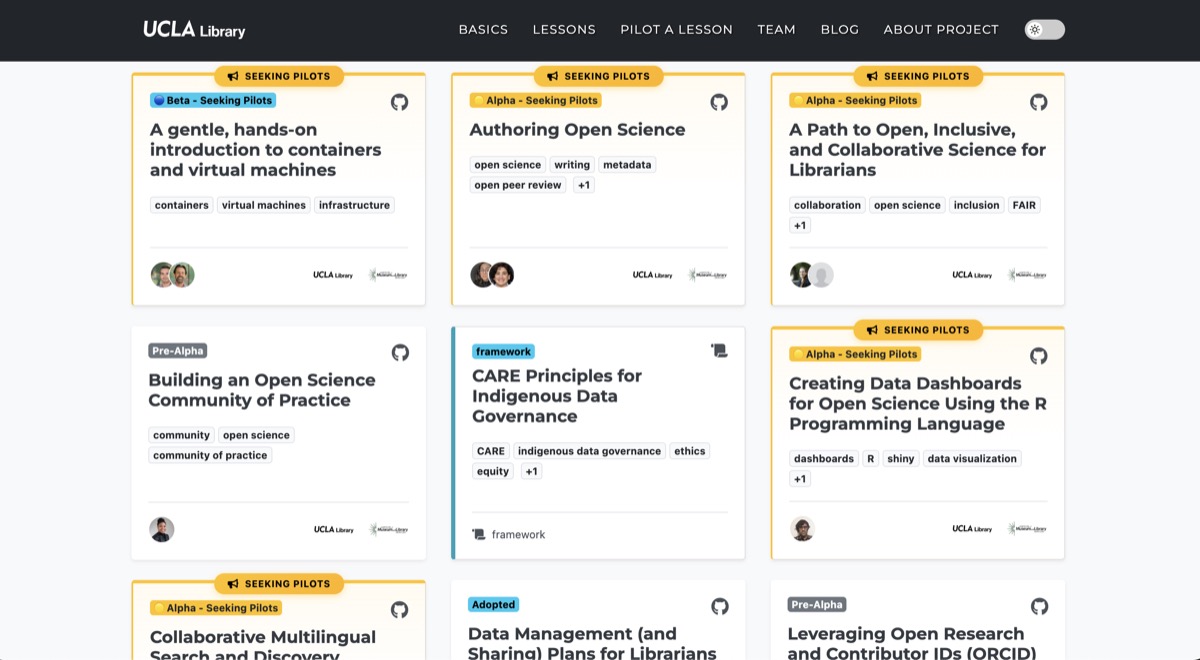
One of these lessons, Data Management Plans 101, has already been officially adopted by Library Carpentry. The remaining 14 lessons are currently in Alpha status and ready for community piloting. To move them toward Beta and eventual adoption, we need the Carpentries community to help us test them in real-world settings.
How You Can Help
We are looking for instructors to run pilot workshops. A pilot is a chance to test lesson materials in authentic teaching environments. You don’t need to be an expert in the topic—in fact, testing lessons with instructors who didn’t write them is exactly what these curricula need to mature.
The Library Carpentry Curriculum Advisory Committee (LC-CAC) is stewarding these lessons beyond the grant period and will use pilot feedback to refine the materials for broader adoption.
If you are interested in teaching any of the lessons below, please indicate your interest using our Pilot Interest tracker.
The Curriculum at a Glance
All lessons are designed for 1.5 to 4 hours of instruction and are built on The Carpentries Workbench. They cover a range of technical, methodological, and community-building topics.
Technical Workflows & Infrastructure
- Cloud Workflows for Librarians (3h): Hands-on experience with SSH, RStudio Server, and reproducible cloud research workflows.
- Containers and Virtual Machines (3h): A gentle, hands-on introduction to research infrastructure.
- Data Dashboards with R/Shiny (3.5h): Teaching researchers to build interactive web applications for data visualization.
- Open Science Hardware (Intro): Fundamentals of OSH licensing, communities, and practices for librarians.
Open Research Methods
- Open Qualitative Research (QualCoder) (4h): Reproducible qualitative analysis using open tools and data from the Qualitative Data Repository.
- Open Qualitative Research (Taguette) (Intro): Applying open science principles to qualitative data analysis.
- Reproducible Research Workflows (Intermediate): Theoretical and practical aspects of reproducibility across disciplines.
Scholarly Communication & Discovery
- Authoring Open Science (3h): Open authoring tools, contributor roles (CRediT), and open peer review.
- NASA Science Explorer (SciX) (4h): Case study exploration of interdisciplinary discovery engines and FAIR principles.
- Multilingual Search & Discovery (3h): Building lightweight discovery systems using Google Sheets and JavaScript.
- ORCID for Librarians (3h): Understanding and using researcher identifiers in practice.
Community & Advocacy
- Inclusive & Collaborative Science (Intro): Overcoming barriers to open science in non-native English speaking communities.
- Open Science Team Agreements (2h): Practical tools for advocating for open practices within research groups.
- Open Science Community of Practice (1.5h): Principles for building and sustaining open science communities within institutions.
What to Expect as a Pilot Instructor
When you sign up to pilot a lesson:
- Preparation: We can connect you with the original lesson authors for a “teach-through” or to answer technical questions about setup and delivery.
- Execution: Use The Carpentries guide on Preparing to Teach to structure your session. Pilots can be formal workshops or informal brown-bag sessions.
- Feedback: After your workshop, provide feedback via GitHub issues on the lesson repository. We strongly encourage using observers or “minute cards” to capture learner experiences in real time.
Your feedback will directly inform lesson refinement and help shape these materials into stable, community-tested resources.
About the Project
This curriculum development effort was led by the UCLA Library Data Science Center with support from the Institute of Museum and Library Services (IMLS) as part of the Laura Bush 21st Century Librarian Program. The project brought together library practitioners, researchers, and open science advocates to create practical, hands-on lessons that address real gaps in librarian professional development.
All lesson materials are openly licensed and freely available. For more information about the project, visit https://ucla-imls-open-sci.info.
Get Involved
Ready to pilot a lesson? Open an issue using our Pilot Interest template or reach out directly to Tim Dennis (tdennis@library.ucla.edu).
Help us turn these drafts into real-world tested resources for the global library community.